Married at First Sight vs L'Amore Vince: Who Really Matches You?
L'Amore Vince: The Best Dating App For Single Working Professionals
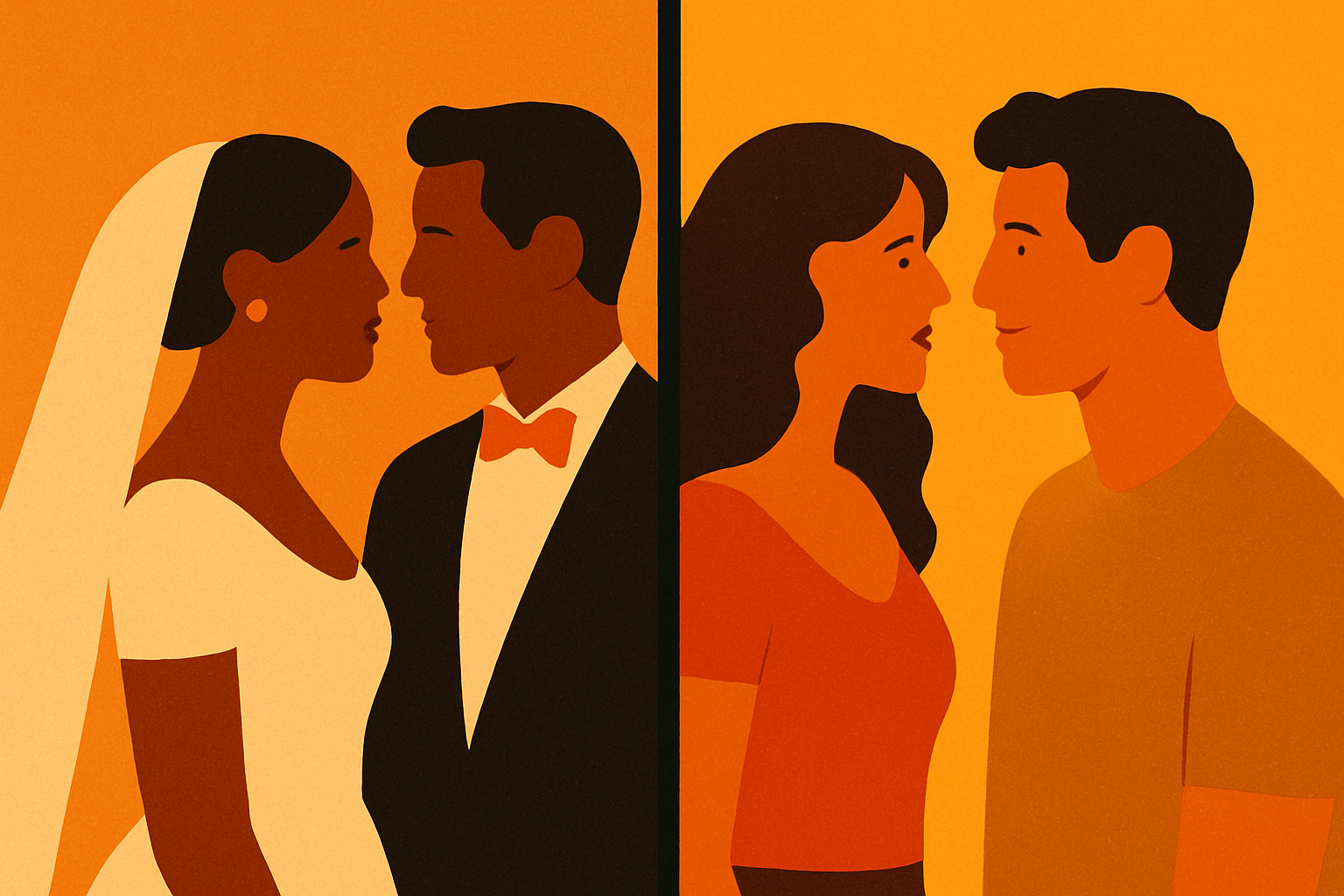
On Married at First Sight, the first time two strangers see each other's face is at the altar, seconds before a legally binding officiant pronounces them married. The show, a format that began in Denmark in 2013 and now runs in more than a dozen countries, films the wedding itself as the introduction. There is no dinner date first. There is a marriage certificate, a stranger standing at the end of an aisle, and a room full of relatives who know more about the match than either participant does.
How the Expert Panel Builds a Match
The matching is done entirely by a small team of relationship professionals, typically a psychologist, a sexologist (a clinician who studies sexual behavior and relationship dynamics), and a matchmaker whose title varies by country. Applicants fill out lengthy questionnaires, sit for one-on-one interviews, and in some seasons complete personality inventories running into the hundreds of questions. The panel weighs values, life goals, attachment history, and family background, then pairs people who neither chooses nor meets before the wedding day. It is expert-matched in the strictest sense of the phrase: participants supply the raw material, but the judgment that turns two profiles into a couple belongs entirely to people the couple has never spoken to.
Compatibility, Calculated Before You Meet
This is where the television format and a reveal-order dating app actually share a premise, even though they execute it in opposite ways. Both start from the assumption that personality and values data predicts long-term compatibility better than a first glance across a room does. An app built around this idea asks its own set of personality questions and converts the answers into a compatibility score, the same kind of figure a matchmaking panel produces after weeks of interviews, except here it arrives in minutes and the person answering the questions can see how their own responses shaped it. Nobody hands their compatibility judgment to a stranger with a clipboard. They build it themselves, one answer at a time.
Decision Day and the Weight of a Legal Contract
The tension that makes Married at First Sight watchable is also its biggest structural risk. Participants are legally married before they have had a single unscripted conversation with each other. Compatibility gets tested under maximum pressure, with cameras in the apartment and a produced timeline pushing toward what the show calls Decision Day, the point roughly eight weeks in when each couple must decide, on camera, whether to stay married or file for divorce. Attraction, daily compatibility, even basic physical chemistry get sorted out retroactively, after the legal and physical commitments are already in place. The order is backward by design, because the backward order is the entertainment.
An Alternative Order: Substance First, Face Last
A reveal-order app inverts that sequence instead of removing it. Matched users move through timed rounds in a fixed order: a text-based conversation first, then a voice call, then video, and only after that, contact information. Either person can pass at any round, so nobody is locked into a legal or physical commitment before deciding the conversation is worth continuing. The physical reveal that Married at First Sight compresses into a single wedding ceremony happens last in this model, after days or weeks of actual back-and-forth, and it is opt-in at every stage instead of mandated by a shooting schedule.
What Verification Solves That a Casting Panel Can't
Married at First Sight solves for one kind of risk. Its panel vets applicants through background checks and clinical interviews before casting, so viewers can trust that the people on screen are who the show says they are, at least on the day they signed the contract. A reveal-order app solves an adjacent but different problem, the one ordinary dating apps have struggled with for years: knowing that the person a user is texting today is a real, currently active human, not an old photo or an automated account. That gets handled through a daily face-verification check-in that builds a visible streak, so the trust a television panel manufactures once, during casting, gets rebuilt automatically every day a match stays open.
L'Amore Vince runs on the same underlying belief as the panel behind Married at First Sight, minus the cameras and the legal contract: that compatibility is something built from what two people actually say to each other, not from how they look the moment they meet.
Quyền truy cập sớm được dành trước cho những người trong danh sách.
Bài viết liên quan
Snack vs L'Amore Vince: Why Video Comes First or Last
Ten Seconds to Judge a StrangerSnack's profile builder gives new users a short timer, usually around ten seconds, for each video clip they record, and it asks for several of these clips before the app will show a single match. The result is a profile that looks and moves like a TikTok feed: a…

Her's Queer Community Feed vs. L'Amore Vince's Verified Slow Reveal
Her, the dating and social app built specifically for lesbian, bisexual, and queer women along with nonbinary and trans users, has kept a scrollable tab labeled Community on its home screen since roughly 2016. It sits next to the swipe deck rather than replacing it. Anyone with the app installed…
Christian Mingle vs L'Amore Vince: Faith Filter or Earned Trust?
A Dropdown Menu Before a Last Name Christian Mingle's sign-up form asks new users to pick a denomination, the specific branch or tradition of Christianity they identify with, such as Baptist, Catholic, Non-denominational, or Orthodox, before it asks for a last name or a bio. That ordering is…
Comments
Tham gia bình luậnHãy là người đầu tiên bình luận.