Dating as a Woman in DC: When Everyone Has an Agenda
Power is the dating pool.
The City That Never Stops Running Its Resume
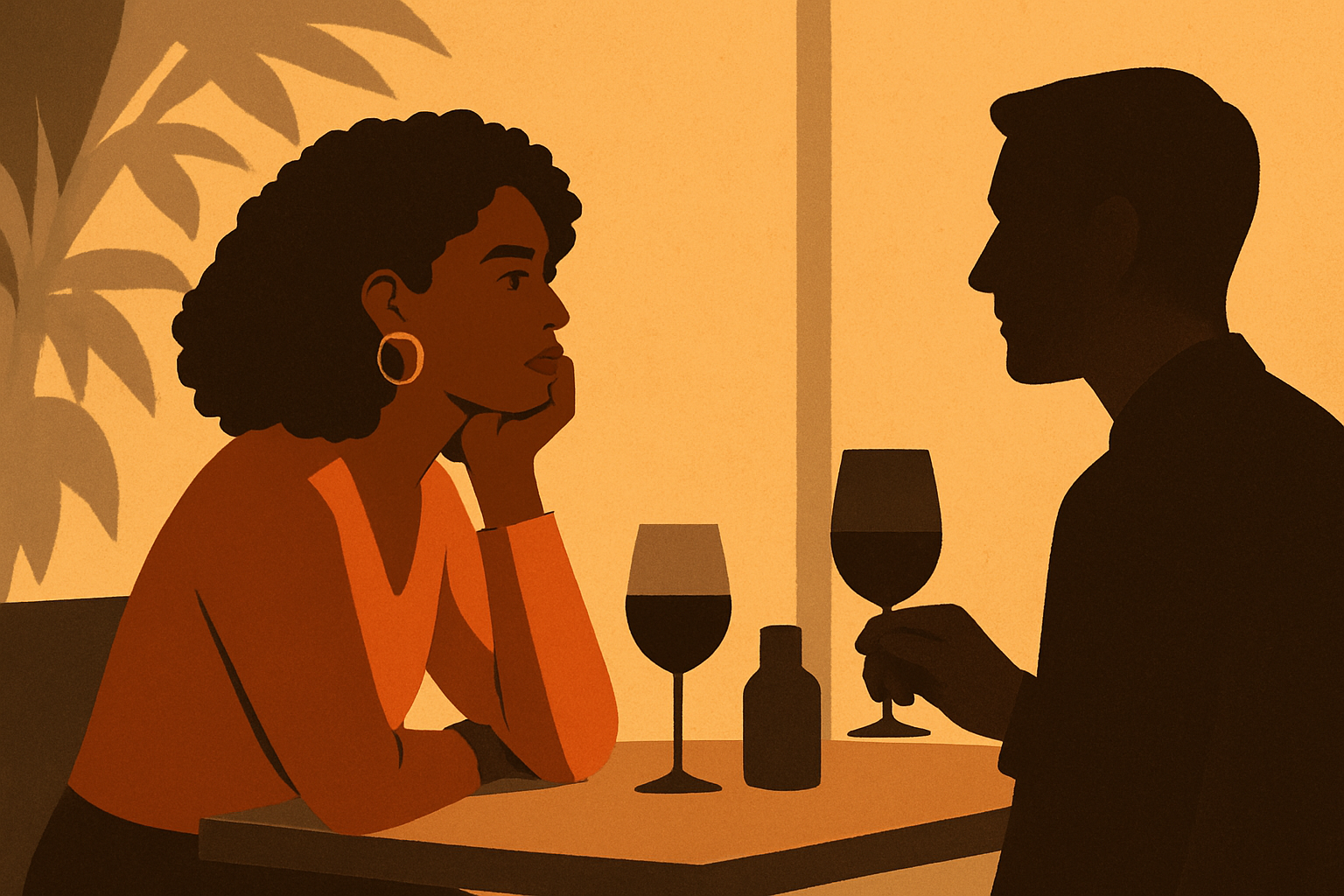
Washington DC is unlike any other city to date in as a woman — and not in the romanticized, cherry-blossom postcard way people imagine when they've never actually lived here. This is a city where the first question at every party, every rooftop bar in Shaw, every awkward first date at a wine bar on 14th Street NW is: what do you do? Not where are you from, not what are you passionate about, not even the generic small talk people exchange in other cities. Here, your job is your introduction, your status signal, and often your romantic filter — all at once.
Women who date in DC know a specific exhaustion that is hard to explain to friends in other cities. It is the exhaustion of figuring out, within the first twenty minutes of meeting someone, whether they are genuinely interested in you or in what you represent: your clearance level, your Hill connections, your proximity to power. The city runs on proximity to power, and that fact warps dating culture in ways that are entirely unique to this ZIP code.
The Neighborhoods, and What They Mean for Your Love Life
DC is a city of neighborhoods that function almost like separate ecosystems. Where you choose to live quietly signals who you are and who you are likely to meet.
Capitol Hill is its own universe — staffers and lobbyists who keep brutal hours, whose social lives rotate around The Hawk 'n' Dove and caucus vote schedules. Dating on the Hill means competing with a congressional calendar. Recesses are peak romance season. The rest of the year, you get stood up for a floor vote.
Dupont Circle has historically been DC's queer and arts heartland, and women dating women here often describe a more values-first culture — though the neighborhood's rapid gentrification has shifted who actually lives there versus who just brunches there on weekends.
Columbia Heights and Petworth attract a younger, more diverse crowd, often people who consciously opted out of the federal government or consulting pipeline and ended up in nonprofit work, journalism, or the arts. The dating culture here is warmer, more neighborhood-rooted, but the transience problem is just as acute.
Georgetown skews toward old money, law school students, and people who moved here for a specific two-year fellowship and have been saying they're leaving ever since. Dating in Georgetown as a woman can feel strangely formal — there is a cocktail-party performance quality to it that wears thin fast.
Navy Yard and the Southwest Waterfront are the newer developments that drew a wave of transplants post-2015. It is where you find the people who use DC as a launching pad, not a home. They are charming, they are available, and they are very possibly leaving in eighteen months.
The Transience Problem Is Real, and It Is Gendered Differently Here
Every big city has transience. DC's version is different because it is structured and predictable in a way that actually makes it harder, not easier, to navigate. Presidential administrations turn over. Senate offices flip. International organizations rotate their staff every three years by policy. Think tanks hire two-year fellows. Every four to eight years, a significant portion of the dating pool either leaves town or digs in permanently — and the people who dig in are often not the same people who were exciting to date when they first arrived.
Women in their late twenties and thirties in DC describe a particular frustration: meeting someone compelling, building something real over several months, and then watching the job that brought them here simply expire. This is not ghosting. It is not a failure of connection. It is a structural feature of the city, and it disproportionately affects women who, research consistently shows, are more likely to have turned down relocation opportunities to stay somewhere they have built community.
"I have had three relationships end not because anything was wrong but because the other person's visa expired or their fellowship ended. DC doesn't break your heart dramatically. It just quietly reorganizes the people you love."
The Credential-First Culture and What It Does to Intimacy
There is a specific dynamic that women who date men in DC describe with striking consistency: the moment a date finds out you work somewhere impressive — say, a federal agency at a senior level, or a well-known think tank, or a corner office on K Street — the energy in the room changes. Sometimes it opens up. Sometimes it creates a strange competitive undercurrent. And almost always, it means the conversation pivots away from you as a person and toward your institutional affiliation.
This is a problem that is distinct from the general professional-women-aren't-taken-seriously problem that exists everywhere. In DC, credentials are the social currency, and when a woman has a lot of them, it triggers a specific discomfort in certain men who came here expecting credentials to be their differentiator. The result: women in DC often find themselves strategically vague about their jobs on early dates, not out of modesty, but as a self-protective filter. If he can't handle not knowing your title for the first hour, that tells you something.
The Photo Problem and What DC's Aesthetic Pressure Costs Women
DC has an underrated but real aesthetic conformity in its professional culture. The uniform on the Hill is recognizable. The Bethesda-to-downtown commuter has a look. The nonprofit world has its own version of business casual that signals a very specific set of values. On photo-first dating apps, women in DC navigate a double bind: looking too polished signals one kind of political alignment, looking too casual signals another. The city reads appearances through an ideological lens in ways that New York or Los Angeles simply do not.
And then there is the safety dimension, which is not unique to DC but is acute here. Women in any major city know the calculus of how much personal information to put into a profile photo — which neighborhood is visible behind you, whether your workplace is identifiable, whether your face alone is enough for someone determined to find out where you run on weekend mornings. In a city full of people who have security clearances and genuinely sensitive jobs, this concern is not paranoia. It is professional prudence.
What Women in DC Are Actually Looking For
Spend time talking to women who date in this city and a clear picture emerges. They are not looking for someone with a more impressive title. They largely have impressive titles. They are not looking for someone to show them the city — they know the city. What they consistently describe wanting is someone who is genuinely curious about them as a person before they are curious about them as a professional asset. Someone who has a conversation before forming a judgment. Someone who is actually present in a city where everyone's mind is at least partly on the next meeting, the next election cycle, the next confirmation hearing.
They want to be known before they are evaluated. That is a deceptively simple thing that DC's status-first culture makes surprisingly rare.
A Different Kind of First Impression
What L'Amore Vince is built around is the idea that the photo-first swipe is the wrong starting point — that you should know someone's values, hear their voice, and feel a real conversational chemistry before you ever see their face. The app moves matched users through timed rounds: text first, then audio, then video, then — only when both people choose it — contact exchange, with a masked forwarding number available so neither person has to hand a stranger their real phone number before they are ready.
Compatibility is calculated from personality question answers, not appearance. And every user completes a daily liveness check-in — a quick face verification — that builds a visible verified streak, so the person you are talking to in round one has been confirmed as a real person, not a profile assembled from borrowed photos and borrowed credentials. In a city where professional identities are performed as much as they are lived, and where women have very good reasons to be careful about how much of themselves they reveal to whom and when, that structure is not a gimmick. It is just a more honest sequence.
DC will keep being DC — the resume culture, the transience, the strange glamour of proximity to power, the cherry blossoms that briefly make everyone forget the city is held together by ambition and anxiety. But the women here who are dating seriously are increasingly clear about what they need: to be a person first. To be seen for substance before surface. The city has never exactly made that easy. Some tools are starting to.
Bài viết liên quan

Dating in El Paso as a Woman: The City That Walks You Home
By late Sunday afternoon in El Paso the grill smoke stands over whole neighborhoods at once, the Lower Valley, the Northeast, the westside cul-de-sacs, and inside that smoke, at folding tables in backyards, sits the institution that actually governs a woman’s romantic life here: her grandmother.…

Dating in Portland, Maine as a Woman: Small Harbor, Long Memory
On a Saturday night in July, Wharf Street is wall to wall with bachelorette parties, sashes and matching shirts and men down from elsewhere shouting compliments that nobody requested, and a Portland woman threading through it is usually on her way somewhere else. Come back to the same cobblestones…

Dating in Provo as a Woman: The Ward Calendar and the Dirty Soda
At nine on a weeknight the drive-through line at a Provo soda shop runs ten cars deep, and a fair share of those cars are dates. The dirty soda, a fountain drink dressed with cream and syrup and lime, is Utah County’s answer to the cocktail, invented for a population that does not drink alcohol or…
Comments
Tham gia bình luậnHãy là người đầu tiên bình luận.