Swipe Fatigue Is Real — Here's Why Slowing Down Fixes It
The Exhaustion Nobody Talks About
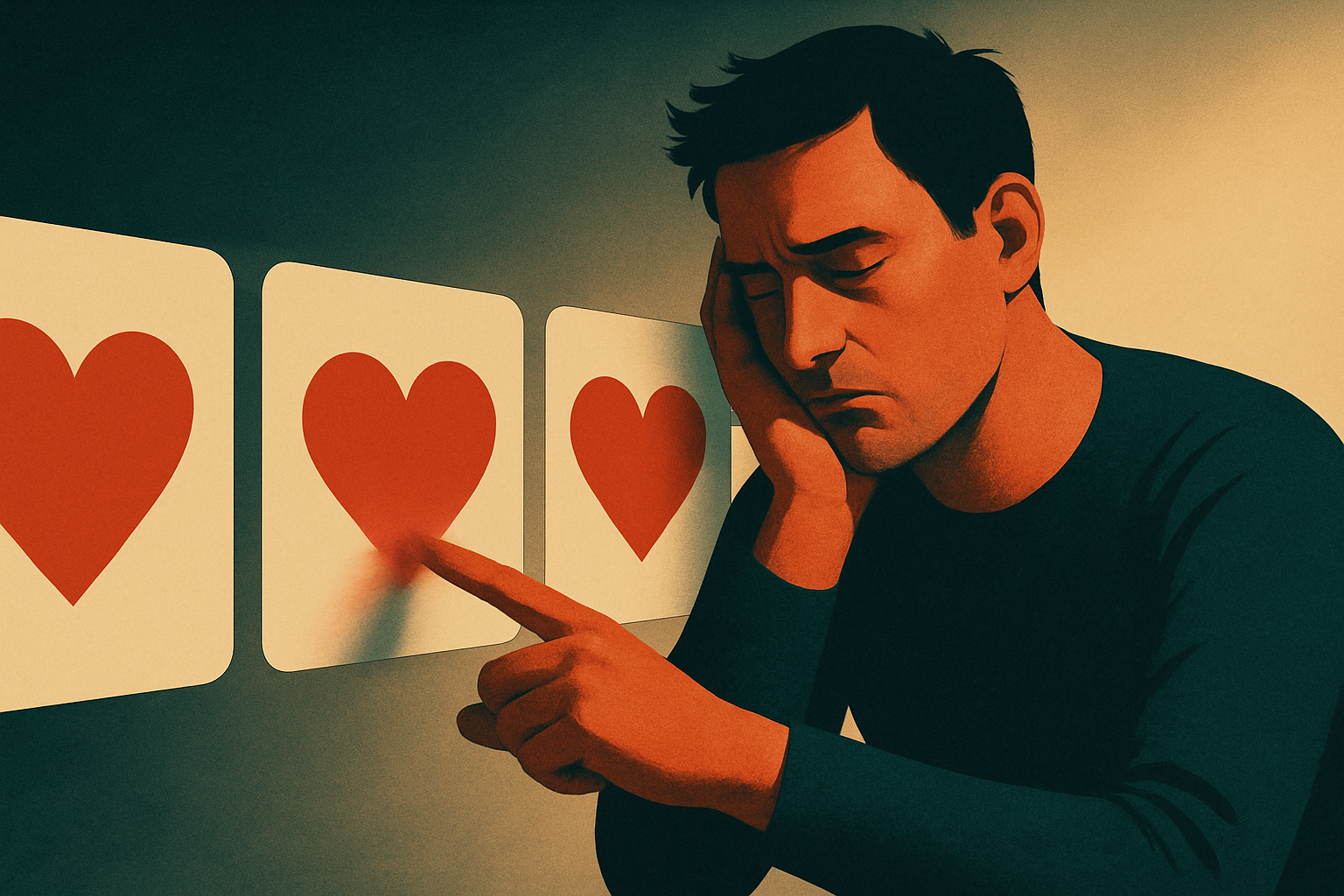
There is a particular kind of tired that sets in after about forty-five minutes on a mainstream dating app. Your thumb keeps moving. The faces blur together. You stop reading bios — if you ever started — and the whole exercise starts to feel less like meeting people and more like scrolling a catalog nobody asked you to shop from.
Dating-app burnout is not a personal failure. It is a predictable output of a specific design philosophy: show photos first, ask questions later, reward speed over depth. The architecture of photo-first swiping trains your brain to make snap judgments hundreds of times per session. And like any muscle worked without rest, the emotional circuitry behind those judgments eventually gives out.
Researchers who study digital dating have a term for this: "decision fatigue." When every swipe demands a micro-evaluation and the stakes feel simultaneously trivial and enormous, the mind eventually opts out. You either delete the app in frustration or slip into a zombie-scrolling mode where you're present in body but absent in intention. Neither version is how anyone imagined online dating would feel.
Why Speed Is the Real Culprit
The pace of conventional apps isn't accidental. Fast loops keep users in the app longer, and engagement metrics look great in investor decks. But what those metrics don't capture is meaning — whether any given interaction felt worth having. Quantity and quality are genuinely in tension here, and most platforms have quietly chosen quantity.
The swipe cycle also creates a psychological trap that behavioral economists call the "paradox of choice." The more options you scroll past, the harder it becomes to feel satisfied with any single one. Every potential match is haunted by the ghost of whoever else might appear if you just keep going. Commitment — even to a simple conversation — starts to feel costly.
The antidote, counterintuitively, is constraint. When your options are intentionally limited and your progress through a connection is structured rather than open-ended, the brain can actually settle. You stop auditioning possibilities and start inhabiting the present one.
What a Progressive Reveal Actually Does to Your Nervous System
L'Amore Vince is built on the premise that attraction rooted in personality is stickier than attraction rooted in appearance. The app moves matched users through four distinct rounds in sequence — text chat first, then voice, then video, then contact exchange — and neither side sees a photo until the connection has already been established through conversation.
This structure does something subtle but significant to the emotional experience. Because the rounds are timed and sequential, there is no infinite scroll, no sense of an endless queue waiting behind your current match. You are here, in this conversation, and the design asks you to be present in it. That boundary alone is a relief.
Starting in text — with no photo to anchor first impressions — forces a different kind of attention. You read what someone says. You notice how they construct a sentence, whether they ask follow-up questions, what they find funny. The first round creates a low-pressure space to be curious without the anxiety of being judged on sight.
By the time voice arrives in the second round, there is already a relationship context — however brief — to step into. The conversation doesn't start cold. You're building on something. That accumulation is what conventional apps skip entirely, and it's exactly what makes the experience feel less like grinding and more like genuine discovery.
Compatibility Before Chemistry: A Different Kind of Match
The matches themselves are different from the start because they aren't built on appearance. LAV computes a compatibility score from answers to personality questions, so the person landing in your queue has already been filtered for alignment on things that actually predict long-term satisfaction — values, communication style, what you're looking for. The score reflects substance, not surface.
This matters for burnout in a specific way. A huge source of exhaustion on photo-first apps is the graveyard of matches that go nowhere — people who looked promising in a thumbnail but turned out to have nothing in common once a conversation stumbled to life. Every dead-end match has a cost: time, hope, the low-grade demoralization of another connection that fizzled. Personality-first matching doesn't eliminate mismatches, but it reduces the noise significantly.
Safety as a Sustainability Feature
Burnout isn't purely emotional. There is a safety dimension too. The chronic low-level anxiety of not knowing whether the person you're talking to is real — whether the profile is current, whether the photos are genuine, whether you're talking to a bot — takes a toll. That ambient distrust is exhausting in a way that's easy to underestimate until it's gone.
LAV addresses this through a daily liveness check-in: a quick face-verification each day that builds a visible verified streak on a user's profile. Every person you talk to has completed this process. The streak is transparent — you can see it — and it means the exhausting question of "is this person real" has already been answered before the first message is exchanged.
Consent at Every Step Reduces Emotional Whiplash
One underappreciated driver of dating-app fatigue is the sense of powerlessness. Things happen to you — a match goes cold, someone unmatches without explanation, a conversation you invested in simply evaporates. The app's architecture provides no structure for closure, no agency over what happens next.
The round-by-round format gives both sides explicit agency at every transition. Either person can choose to pass between rounds rather than advance, and that option belongs equally to both. This means no conversation drags on past the point where one person has mentally checked out, and no one is pulled into a video call before they feel ready. The structure itself is a form of respect.
When you know a pass is always available, the pressure that makes people go silent instead of honest just... dissolves. You can stay present because leaving gracefully is genuinely an option.
The Practical Case for Slowing Down
If you're burned out on dating apps, the instinct is often to take a break — delete everything and step back. That instinct is sound, but the underlying problem isn't apps themselves. It's the specific loop those apps have been designed around. A break from a photo-first swipe machine is a break from a particular kind of experience, not from digital dating as a category.
The case for a slower, more structured approach is ultimately practical:
Fewer connections that go nowhere means less emotional overhead per match.
Structured progression means you know where you are in a connection and what comes next — no ambiguity spiral.
Verified users mean the baseline trust is already established, so you spend less energy on skepticism.
Consent at each round means neither person gets stranded in a dynamic they didn't choose.
No photo-first pressure means the opening conversation is about personality, not performance.
Substance Over Surface Isn't Just a Tagline
LAV's philosophy — substance over surface, consent at every step, safety and verification by default — isn't marketing language designed to sound good. It's a description of specific, deliberate design choices that run counter to the engagement-maximizing defaults of most dating platforms. Those choices have real effects on how it feels to use the app.
Dating-app burnout is what happens when a tool optimizes for the wrong thing. The fix isn't to stop using tools. It's to use ones built around what you actually came for — a real connection with a real person, arrived at honestly, at a pace that lets both of you show up fully. That's a slower road. But it's the one that actually goes somewhere.
Похожие записи

Dating in El Paso as a Woman: The City That Walks You Home
By late Sunday afternoon in El Paso the grill smoke stands over whole neighborhoods at once, the Lower Valley, the Northeast, the westside cul-de-sacs, and inside that smoke, at folding tables in backyards, sits the institution that actually governs a woman’s romantic life here: her grandmother.…

Dating in Portland, Maine as a Woman: Small Harbor, Long Memory
On a Saturday night in July, Wharf Street is wall to wall with bachelorette parties, sashes and matching shirts and men down from elsewhere shouting compliments that nobody requested, and a Portland woman threading through it is usually on her way somewhere else. Come back to the same cobblestones…

Dating in Provo as a Woman: The Ward Calendar and the Dirty Soda
At nine on a weeknight the drive-through line at a Provo soda shop runs ten cars deep, and a fair share of those cars are dates. The dirty soda, a fountain drink dressed with cream and syrup and lime, is Utah County’s answer to the cocktail, invented for a population that does not drink alcohol or…
Comments
Присоединяйтесь, чтобы оставлять комментарии.Оставьте первый комментарий.