Tinder's Swipe vs. L'Amore Vince's Talk-First Reveal

Tinder didn't invent online dating, but it defined the modern shape of it: a stack of photos, a left-or-right flick of the thumb, and a match the instant two people both swipe right. It made meeting people feel effortless and a little like a game. L'Amore Vince keeps the ease but throws out the first move that Tinder made famous — the snap judgment on a face — and replaces it with a conversation.
What Tinder optimized for
Tinder's genius was friction removal. A profile is a few photos and a line of text; a decision takes a fraction of a second; matching is mutual and instant. That speed is why it scaled to hundreds of millions of people. It turned the terrifying act of approaching a stranger into a low-stakes, private yes-or-no.
But everything that makes the swipe fast also makes it shallow. When the unit of decision is a photo, the photo becomes the whole contest. People optimize their grid, not their conversation, and the first thing you learn about someone is the last thing that predicts whether you'll actually get along.
Why the photo-first swipe has a ceiling
The swipe rewards a tiny slice of the pool. Attention piles onto the most photogenic profiles, and everyone else is effectively invisible no matter how well they'd match you. You can be funny, kind, and genuinely compatible and still never get a thumb to pause, because the format never gives those qualities a chance to show up.
It also trains a habit that's hard to switch off: evaluating people as images to be accepted or rejected at a glance. That habit follows you into the conversation, the date, and sometimes the relationship.
How L'Amore Vince inverts the order
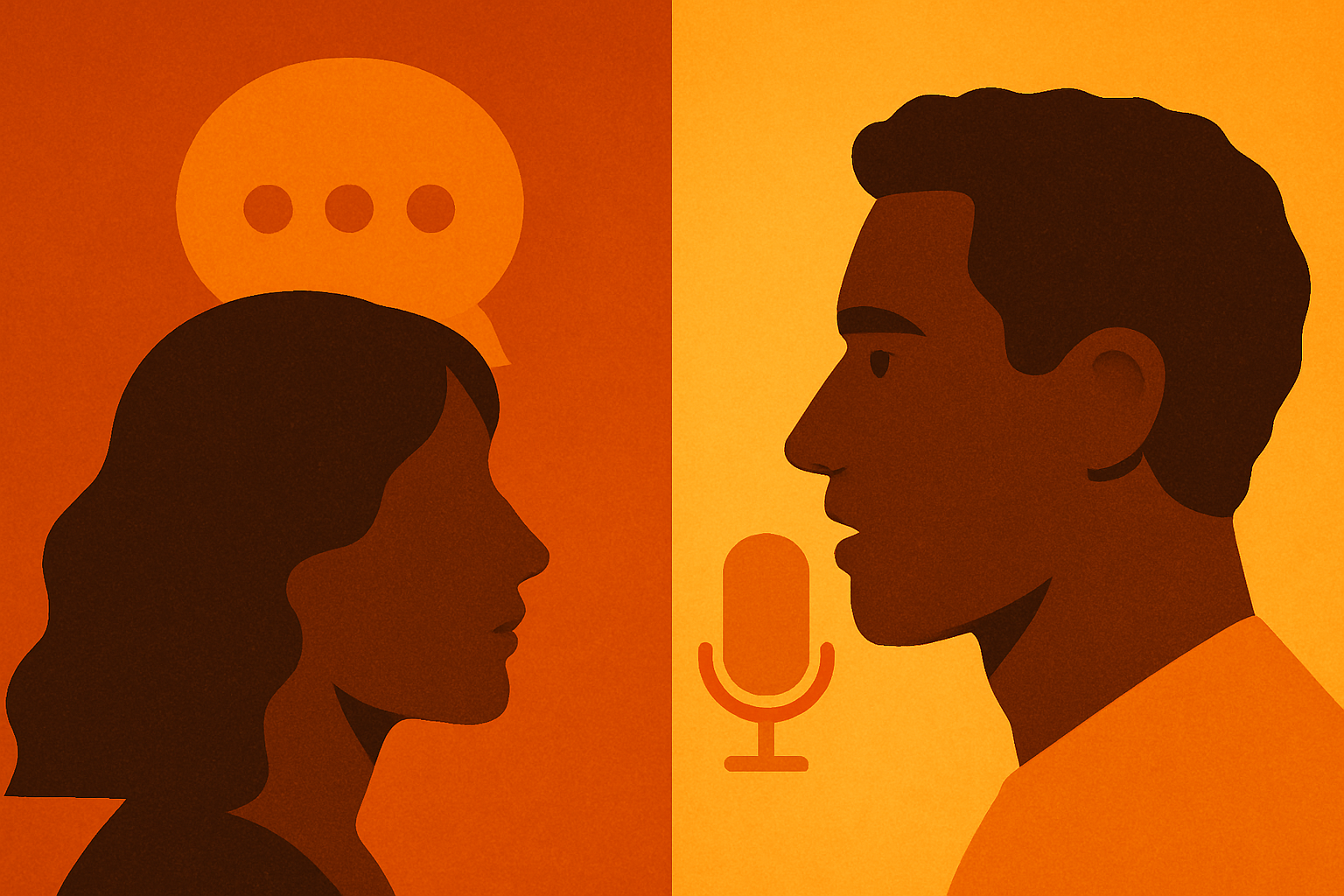
L'Amore Vince starts where Tinder ends. There's no grid of faces to swipe. Instead you're matched on a compatibility score built from your personality answers, and you meet through rounds — text, then voice, then video, then contact — advancing only when both people choose to. You get to know someone before you ever see them.
The face still arrives — it just arrives last, after you already know you enjoy talking to the person. That single reordering changes who gets a chance and how attraction forms.
Talking before seeing
The first round is a real text conversation, not an opener fired at a photo. Because nobody can see anybody, the exchange can't be about looks — it has to be about what you actually say.
Then voice. Hearing someone — their humor, their warmth, the pace of how they think — tells you things a photo never could, and it does it before appearance has had a chance to bias you.
Tinder: see a photo → swipe → match → inbox opens → maybe talk.
L'Amore Vince: match on compatibility → talk → hear → see → exchange contact, each step mutual.
Where the face finally comes in
By the time L'Amore Vince reveals a face in the video round, the question has flipped. On Tinder you ask 'is this person attractive enough to talk to?' On L'Amore Vince you've already been talking, so you're asking 'does the face match the person I already like?' — a far kinder and more accurate way to feel attraction.
The bottom line
Tinder made dating fast by making it visual. L'Amore Vince makes it meaningful by making it patient — looks come last, conversation comes first, and the people you meet were chosen for fit instead of filtered by a photo. Same low-stakes ease to start; a completely different thing at the end of it.
Pos terkait

eHarmony vs L'Amore Vince: Do Compatibility Scores Predict Chemistry?
eHarmony asks new users to complete a questionnaire built around what the company calls its 29 Dimensions of Compatibility model, a battery of items covering personality traits and emotional temperament, alongside stated values about family and ambition, first assembled by psychologist Neil Clark…
Coffee Meets Bagel's Daily Picks vs. LAV's Compatibility Score
Coffee Meets Bagel built its reputation on a simple promise: fewer, better matches delivered once a day. No endless swiping, no decision fatigue — just a curated handful of profiles to consider before your morning coffee goes cold. It's a thoughtful idea, and for a lot of people it was a genuine…
Hinge Prompts vs. LAV's R1 Round: Which Sparks Real Talk?
First conversations on dating apps are notoriously awkward. You're staring at a stranger's profile, trying to say something that isn't "hey" — and usually failing. Hinge built its entire product around solving that problem with prompts. L'Amore Vince took a completely different route. Both…
Comments
Bergabunglah untuk berkomentarJadilah orang pertama yang berkomentar.