Christian Mingle vs L'Amore Vince: Faith Filter or Earned Trust?
L'Amore Vince: The Best Dating App For Single Working Professionals
A Dropdown Menu Before a Last Name
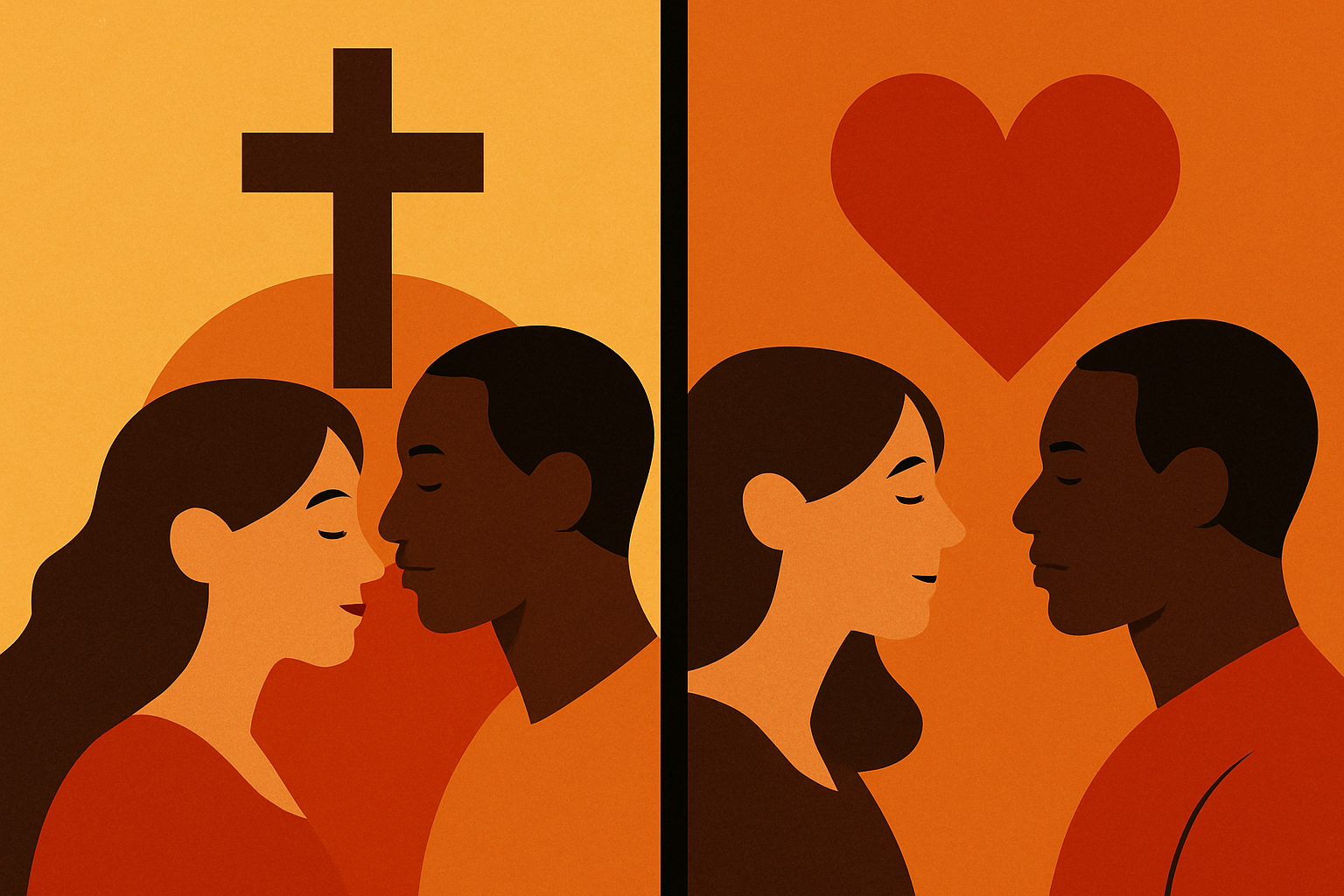
Christian Mingle's sign-up form asks new users to pick a denomination, the specific branch or tradition of Christianity they identify with, such as Baptist, Catholic, Non-denominational, or Orthodox, before it asks for a last name or a bio. That ordering is deliberate. The platform, which launched in 2001 as part of the Spark Networks portfolio and now counts several million active profiles, is built to sort people by stated belief first and personal history second. It is one of the oldest and most direct examples of what dating apps call faith-first filtering: using a self-reported value, in this case religious affiliation, as the primary matching criterion rather than an afterthought buried in an optional field.
What the Filter Actually Sorts For
Faith-first filtering works reasonably well at what it promises. It puts two people who both checked Catholic or both checked non-denominational in front of each other before either has said a word. For users who consider shared religious practice non-negotiable in a future spouse, that is genuinely useful, since it removes a category of incompatibility before a single message gets sent. But the filter only sorts what people type into a dropdown. It has no way to confirm that the person on the other end actually attends services, holds the stated beliefs with any consistency, or is even using their real name and face. A denomination field is a declaration, not a fact, and Christian Mingle, like most legacy dating platforms, does not verify it against anything.
The Verification Gap
That gap matters more than it might seem. Faith-based dating platforms have historically been targeted by catfishing schemes, where scammers build profiles around religious language and scripture references specifically because those signals lower a stranger's guard faster than a gym selfie would. A pious-sounding profile can be just as fabricated as any other kind, and a denomination checkbox does nothing to confirm the person filling it out is a real, single, verified adult. The filtering happens at the level of stated values. The trust problem happens at the level of identity, and those are two different problems that faith-first apps tend to conflate.
A Different Order: Earned Trust
A different approach to the same underlying question, how two strangers know they can trust what the other is showing them, works from the opposite direction. Instead of sorting by a self-reported category up front, it computes a compatibility score from a set of personality question answers, values, communication style, life goals, the kind of substance that actually predicts whether two people get along, rather than the label either of them applies to their beliefs. Matches then move through four timed rounds in a fixed order: text chat first, then a voice-only round, then video, then contact exchange, with either person free to pass between any of them. Nobody sees a face before they have had at least two rounds of actual conversation.
That order does something faith-first filtering can't: it lets people demonstrate consistency before a match ever assumes it. Where Christian Mingle takes a stated identity at face value, this structure asks users to show, in successive rounds, that the person typing is the same person talking is the same person on video. Compatibility is only half of the equation. The other half is verification, handled through a daily liveness check-in, a short face-verification step done once a day that confirms the account belongs to a real, present person, and builds into a visible verified streak the longer someone keeps it up.
Belief vs Behavior: Which One Predicts a Good Match
Shared faith is a real predictor of long-term compatibility for people who want it to be, and no comparison should pretend otherwise. But a declared identity and a demonstrated one are not interchangeable, and the two problems, sorting by values and confirming honesty, don't cancel each other out just because they sit on the same screen. Christian Mingle answers the first question well and mostly ignores the second. It assumes that if two people share a religious label, the rest of the relationship risk takes care of itself, which is optimistic at best given how little a checkbox can confirm about a stranger's intentions.
A slower, verified structure doesn't replace shared values, it just refuses to take them on faith, so to speak. Someone can still specify what matters to them, family, faith, ambition, sense of humor, inside the personality questions that generate a compatibility score. The difference is that nothing about the match depends on a single unverified checkbox holding up under real conversation. Trust, in this model, isn't declared. It's built one round at a time, and it can be revoked by either side at any point simply by choosing not to advance.
For daters who want their values represented early and their trust earned gradually rather than assumed, L'Amore Vince's structure, compatibility scoring paired with a verified, round-by-round reveal, offers a version of faith-first matching that also asks a stranger to prove, daily, that they are exactly who they say they are.
আগেভাগে অ্যাক্সেস প্রথমে পান তালিকায় থাকা ব্যক্তিরা।
সম্পর্কিত পোস্ট

Snack vs L'Amore Vince: Why Video Comes First or Last
Ten Seconds to Judge a StrangerSnack's profile builder gives new users a short timer, usually around ten seconds, for each video clip they record, and it asks for several of these clips before the app will show a single match. The result is a profile that looks and moves like a TikTok feed: a…

Her's Queer Community Feed vs. L'Amore Vince's Verified Slow Reveal
Her, the dating and social app built specifically for lesbian, bisexual, and queer women along with nonbinary and trans users, has kept a scrollable tab labeled Community on its home screen since roughly 2016. It sits next to the swipe deck rather than replacing it. Anyone with the app installed…

Married at First Sight vs L'Amore Vince: Who Really Matches You?
On Married at First Sight, the first time two strangers see each other's face is at the altar, seconds before a legally binding officiant pronounces them married. The show, a format that began in Denmark in 2013 and now runs in more than a dozen countries, films the wedding itself as the…
Comments
মন্তব্য করতে যোগ দিনসর্বপ্রথম মন্তব্য করুন।