Why Your Voice Reveals What Your Texts Never Could
L'Amore Vince: The Best Dating App For Single Working Professionals
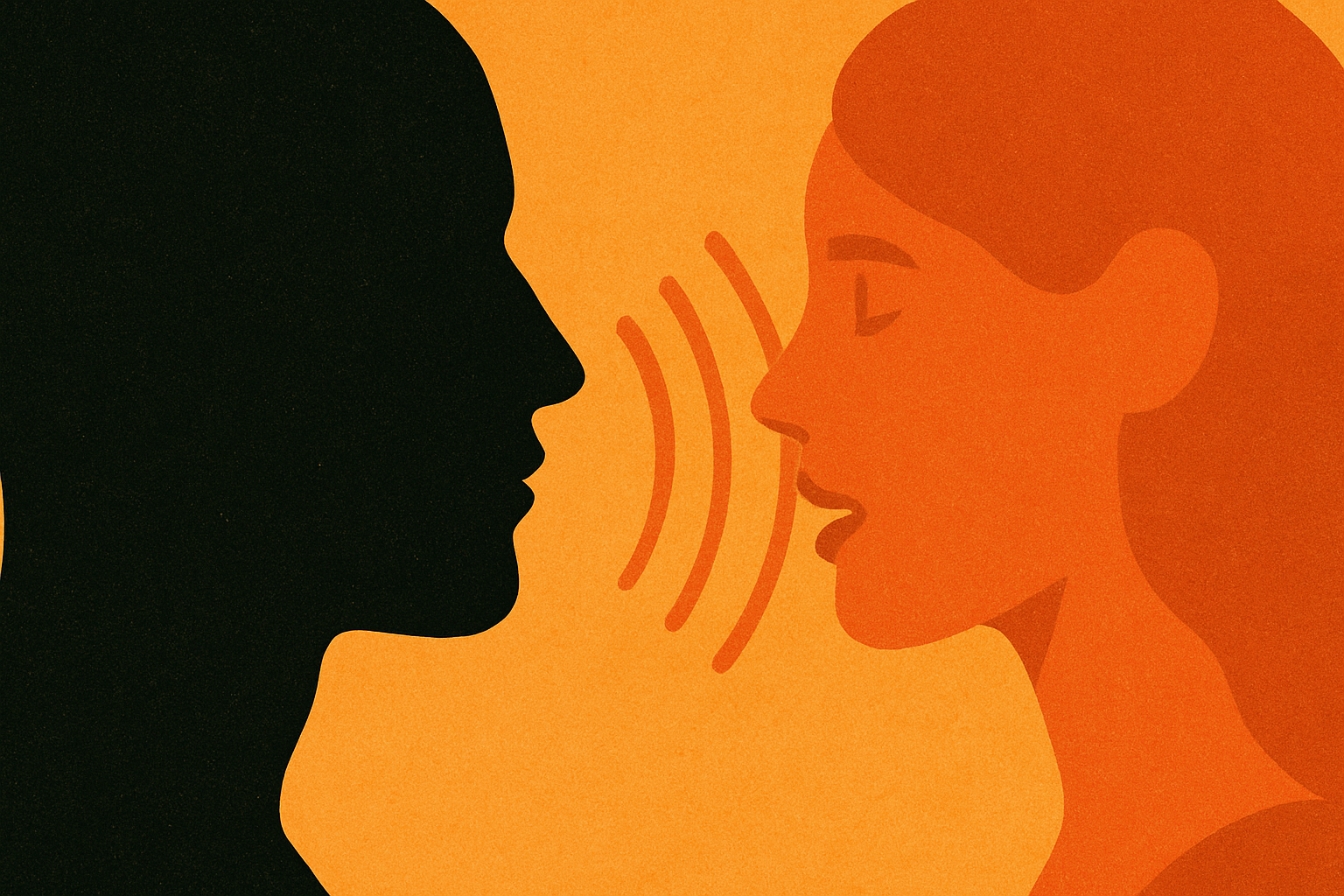
We live in the golden age of written communication. We text, DM, caption, comment, and emoji-react our way through relationships that sometimes never graduate to a single spoken word. And yet, something keeps nagging at us — a persistent sense that the person we've been chatting with for two weeks is still somehow a stranger. There's a reason for that feeling. It turns out the voice carries things that text simply cannot.
The Problem With Performing on Paper
Text messaging handed us an extraordinary power: the power to edit ourselves before anyone hears us. We draft, delete, rephrase, and time our replies to project exactly the version of ourselves we want to show. In everyday life, that's a useful social skill. In early dating, it becomes a trap.
When every message is a small performance, you stop finding out who someone actually is and start finding out how well they can write a charming paragraph. Wit, grammar, and response timing become proxies for personality. The result is a kind of pen-pal dynamic that feels intimate but is surprisingly shallow — because you've been talking to their edited highlight reel, not to them.
What Happens When You Hear Someone for the First Time
The shift that happens when you move from text to voice is hard to overstate. Suddenly you're no longer reading a person — you're receiving them. Pitch, pace, pauses, laughter, hesitation: all of it arrives unfiltered and unrehearsed in a way that typed words never can be. Researchers in paralinguistics have long established that a significant portion of emotional communication travels through vocal tone rather than word choice. You can write 'I'm fine' and mean anything at all. You can't quite fake it when you say it.
This is why voice calls have long been the dividing line in early relationships — the moment where chemistry either crystallises or quietly dissolves. People routinely describe a first phone call as feeling more revealing than weeks of texting. The voice round isn't just a step forward in convenience; it's a qualitatively different kind of knowing.
The Cultural Swing Back Toward Audio
Something interesting has been happening in digital culture over the last few years. Voice notes have exploded in popularity across messaging platforms. Podcasts have trained millions of people to form deep parasocial bonds with voices they've never seen a face attached to. Audio-first social apps had a brief but genuinely passionate following. Audiobooks are outpacing ebooks in growth. The pattern is clear: people are hungry for the intimacy that only voice can deliver.
Part of this is reaction. After years of hyper-visual social media — filters, ring lights, curated feeds — there is a growing fatigue with the performance of appearance. Voice strips that away. You can't apply a filter to your laugh. You can't run a vocal fry through Facetune. What you hear is genuinely what you get, and for a lot of people, that rawness has become its own form of luxury.
What Voice Signals That Text Masks
Energy level and enthusiasm — do they light up when a topic comes up, or does the air go flat?
Nervous honesty — the slight catch in the voice when someone says something they genuinely mean.
Listening quality — do they pause naturally, or do they barrel over every gap in the conversation?
Real laughter — not 'haha' or 'lol', but the involuntary kind that tells you something genuinely landed.
Comfort with silence — whether shared quiet feels companionable or panicked.
Why the Order of Rounds Actually Matters
L'Amore Vince is built on the premise that the sequence in which you learn about someone shapes how you ultimately see them. Text comes first — a space to find conversational rhythm, share ideas, and let a genuine compatibility score (built from personality questions, not photos) do some of the early heavy lifting. Then comes voice. Only after that does video enter the picture, followed by the option to exchange contact details.
Placing voice before video is a deliberate inversion of what most apps do. Usually you see someone first, then maybe speak to them. LAV flips that. By the time you hear a match's voice, you've already built a mental picture from conversation and personality alignment. The voice then either deepens that picture or quietly redirects it — both outcomes being genuinely valuable. When the visual reveal finally comes in the video round, it lands in a completely different emotional context: you're not asking 'is this person attractive?' You're asking 'does this face match the person I've been getting to know?'
By the time you hear a match's voice, you've already built a mental picture from conversation and personality alignment. The voice then either deepens that picture or quietly redirects it — both being genuinely valuable outcomes.
The Safety Dimension Nobody Talks About
There is a practical safety argument for voice-first connection that often gets overlooked in the romanticism of 'deeper intimacy.' A real voice is extraordinarily difficult to fake at scale. Text-based catfishing and bot accounts thrive precisely because written messages are easy to generate, steal, and impersonate. A genuine, spontaneous voice conversation is a completely different challenge.
LAV reinforces this with its daily liveness check-in — a quick face-verification that builds a visible verified streak on every profile. This means that when you arrive at the voice round with a match, you're already speaking to someone who has been confirmed as a real, present human being — not just on the day they signed up, but every single day they've been active. The voice round and the verified streak work together: one confirms authenticity technically, the other confirms it humanly.
Rethinking What 'Chemistry' Actually Means
We tend to treat chemistry as a visual phenomenon — a spark that either ignites when you see someone or doesn't. But anyone who has fallen harder for a person after hearing them speak about something they love knows that chemistry is far more dimensional than that. It lives in cadence and warmth, in the way someone's voice softens when they're being genuinely vulnerable, in the rhythm of a conversation that just flows.
The cultural swing toward voice is, at its core, a recalibration of what we find attractive. It's a growing collective acknowledgment that a beautiful face without a compelling presence is hollow, and that a compelling presence can make you see someone entirely differently. Voice is where presence lives. It's why radio hosts inspired devoted listeners for decades before anyone thought to put them on television. It's why the best storytellers make you close your eyes.
An Invitation to Slow Down and Actually Listen
There's something quietly countercultural about choosing to hear someone before you see them. It runs against the grain of an attention economy that has trained us to make snap visual judgements and scroll on. It requires a kind of patience that, paradoxically, most people report finding deeply enjoyable once they try it.
If you've been feeling like modern dating has too much surface and not enough signal, the answer might be simpler than you think. Put the photos away for a moment. Ask a genuine question. And then — just listen.
منشورات ذات صلة
Dating in El Paso as a Woman: The City That Walks You Home
By late Sunday afternoon in El Paso the grill smoke stands over whole neighborhoods at once, the Lower Valley, the Northeast, the westside cul-de-sacs, and inside that smoke, at folding tables in backyards, sits the institution that actually governs a woman’s romantic life here: her grandmother.…

Dating in Portland, Maine as a Woman: Small Harbor, Long Memory
On a Saturday night in July, Wharf Street is wall to wall with bachelorette parties, sashes and matching shirts and men down from elsewhere shouting compliments that nobody requested, and a Portland woman threading through it is usually on her way somewhere else. Come back to the same cobblestones…
Dating in Provo as a Woman: The Ward Calendar and the Dirty Soda
At nine on a weeknight the drive-through line at a Provo soda shop runs ten cars deep, and a fair share of those cars are dates. The dirty soda, a fountain drink dressed with cream and syrup and lime, is Utah County’s answer to the cocktail, invented for a population that does not drink alcohol or…
Comments
انضم إلينا للتعليقكن أول من يعلق.