Dating as a Woman in Guangzhou: Substance in a City That Never Slows Down
L'Amore Vince: The Best Dating App For Single Working Professionals In Guangzhou China
Guangzhou Runs on a Different Clock
Guangzhou does not wait for you. The city wakes up early — vegetable traders haggling before dawn at Jiangnan Market, factory shifts turning over in Haizhu before most cities have brewed their first coffee — and it stays loud and humid and alive long past midnight in Zhujiang New Town's bar clusters. If you are a woman trying to date here, this pace is both the texture of your daily life and the first obstacle. Time is not something Guangzhou gives back easily, and spending it on someone who turns out to be nothing like his profile is a particular kind of exhausting that women in this city know well.
Canton has always been a trading city — practical, commercial, outward-facing. Romance here has never been wrapped in the same layers of literary romanticism that you might find further north in Beijing, or the performative modernity of Shanghai. Guangzhou's version of courtship is faster and more pragmatic, which has advantages, but it also means that surface judgments happen quickly. You get sized up fast, and so does he.
The Specific Pressures Women Here Actually Navigate
There is a particular social geography to dating as a woman in Guangzhou that outsiders miss entirely. The city is a major destination for internal migration — enormous numbers of young professionals have moved here from Hunan, Guangxi, Jiangxi, and elsewhere, which means the dating pool is genuinely diverse in background but often unified in one shared condition: everyone is building something, nobody has much room to be wrong about a person.
Women in their late twenties and early thirties here face what can feel like a three-sided pressure: family expectations about marriage timelines (the concept of 剩女, shèngnǚ, still carries weight in dinner-table conversations even if younger Cantonese families have softened on it), professional ambition that the city actively rewards, and a dating environment where apps have made first impressions almost entirely visual. Walk through Tianhe on a Saturday evening, past the crowds outside Grandview Mall or along the Pearl River promenade near Ersha Island, and you can see women dressed meticulously for dates with men they met on an app — men who chose them from a photograph before knowing a single thing about them.
"I went on fourteen first dates last year. I can tell within ten minutes whether the photo was recent. That's the part I'm tired of — that the whole first meeting is just verifying the photograph." — a 29-year-old product manager in Tianhe District
The Photo Problem Is Worse Here Than People Admit
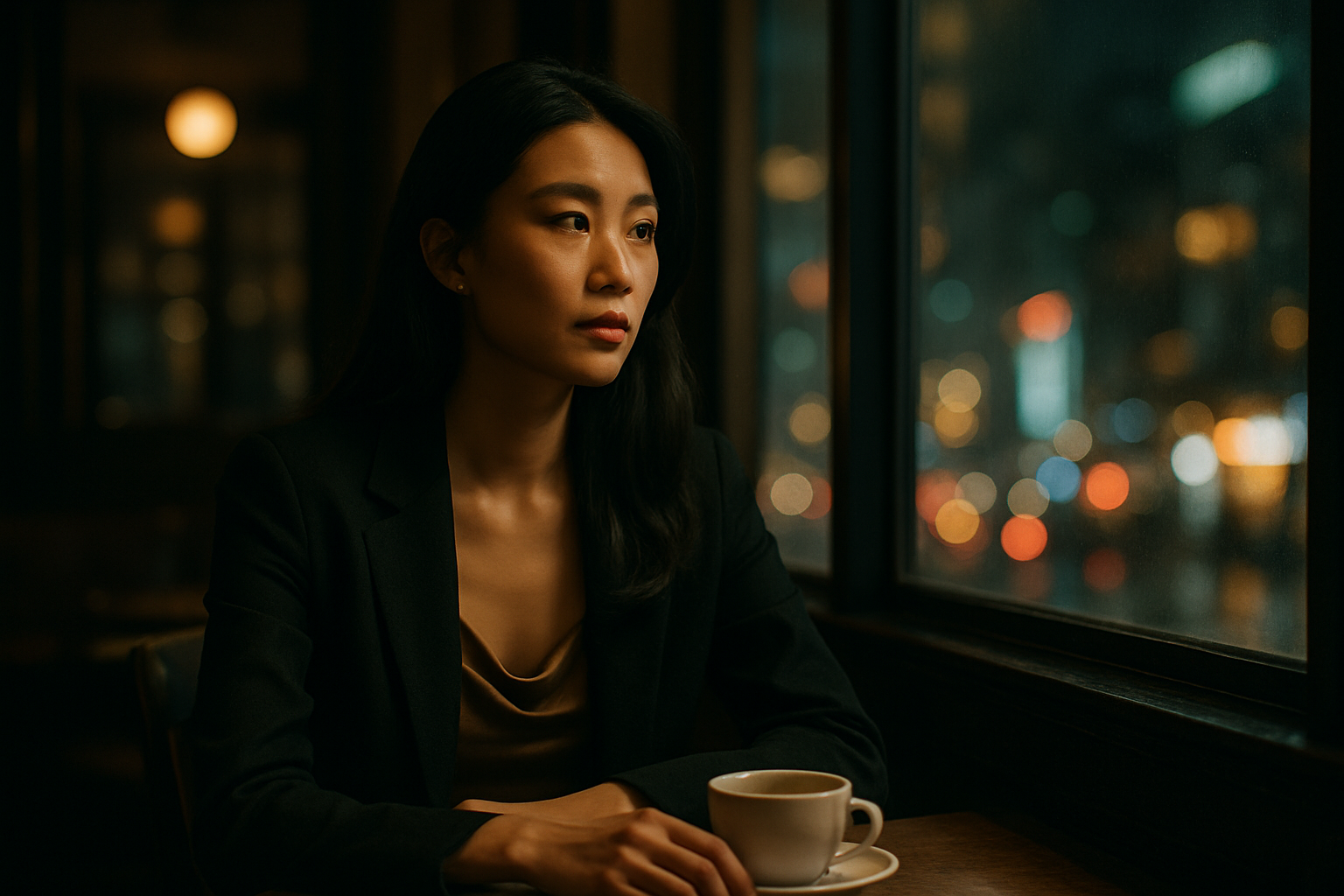
China's beauty filter culture is not abstract — it is embedded in the camera apps installed on almost every phone, and it has created a specific kind of mismatch that women in Guangzhou cite constantly. Men use heavily filtered photos; some use photos from five or ten years ago. Women do the same. The result is that meeting in person often feels like a mutual unmasking, and not always a generous one. The first meeting at a café in Yuexiu or along the quieter stretches of Shamian Island carries a specific anxiety: who actually showed up?
And then there is the safety dimension. Guangzhou is a large, dense, geographically complex city — Baiyun in the north feels nothing like Nansha in the south, and meeting a stranger for the first time in a place you do not know, someone whose real identity you cannot confirm, is a legitimate concern. Women here, like women everywhere, carry this calculation with them. But the scale and anonymity of a city of eighteen million makes it particularly sharp.
What Guangzhou Women Actually Want from Romance
Spend any time in the dating conversations happening in Guangzhou's rooftop bars in Haizhu, in the late-night congee shops of Liwan where couples talk for hours over 及第粥, or in the co-working cafés of Tianhe where someone is always catching feelings for a colleague, and certain desires emerge consistently:
To be known before being seen. Women here talk about wanting a man to be genuinely interested in who she is — her opinions, her humor, her values — before the visual judgment happens.
Verification without awkwardness. Knowing the person is real — not a scammer, not a catfish, not someone operating five simultaneous relationships — matters enormously, but asking for it bluntly feels socially difficult in Cantonese dating culture, where indirect communication is still the norm.
Privacy around contact details early on. Giving a phone number to someone before you trust them is a specific discomfort — WeChat adds can feel like giving someone a key to your social world, since your WeChat is often also your professional identity.
Compatibility over chemistry at first glance. The women who are done with purely appearance-based matching are often the ones who have more self-knowledge — they know what they value and want a process that surfaces that, not one that buries it under aesthetics.
The Cantonese Dimension
Guangzhou is one of the few major Chinese cities where local Cantonese identity still exerts a strong pull on dating preferences. Among women who were raised here, speaking Cantonese natively is not a small thing — it is cultural identity, family language, the tongue in which you understand jokes and softness and what someone really means. Some Guangzhou-born women describe a particular friction when dating Mandarin-speaking migrants, not from hostility but from the feeling that something essential gets lost in translation, literally. The linguistic dimension of intimacy here is specific to this city in a way that does not exist to the same degree in Beijing or Chengdu.
Cantonese dating culture also tends to be more reserved about emotional expression in early stages — 含蓄 (hán xù), the quality of emotional restraint and indirectness, is prized, and women here sometimes describe the frustration of not knowing whether a man is genuinely interested or simply being polite. The subtext is doing enormous work, and reading it requires time and conversation — which is precisely why jumping straight to visual judgments from photos is such a poor fit for how connection actually builds here.
A Different Kind of Process
The things that women in Guangzhou are asking for from modern dating — real identity, substance before aesthetics, privacy at the beginning, compatibility that goes deeper than a face — are not impossible to design for. They are just poorly served by apps that were built around a photograph as the first and loudest piece of information.
L'Amore Vince was built around a different sequence entirely. Matches begin with text — real conversation, personality-based compatibility scores drawn from how you actually answered questions, ice-breaker games to get past the stiff early exchanges. Voice comes second, which in the context of Guangzhou is not a small thing: you hear whether someone is warm or cold, nervous or confident, before you have ever formed a visual impression of them. Video comes only after that, as a third stage. Nobody is chosen for their photograph. Either side can pass between rounds — consent is built into the structure, not tacked on.
The verification question — the one that matters most to women navigating a city of eighteen million strangers — is handled through a daily liveness check-in, a quick face-verification that builds a visible streak over time. Everyone you talk to has passed it, repeatedly. You do not have to ask. And when the point comes where contact exchange makes sense, L'Amore Vince offers a masked forwarding number so that a real phone number — with all the WeChat implications that carries in China — does not have to change hands until you have decided you genuinely want it to.
Guangzhou will keep moving at its own pace. The city is not going to slow down and give you more time. But the process of getting to know someone before you judge them — hearing who they are before you see what they look like — is something a city this pragmatic should actually appreciate. Substance was always the Cantonese way of doing business. It might as well be the way of falling in love too.
منشورات ذات صلة

Dating in El Paso as a Woman: The City That Walks You Home
By late Sunday afternoon in El Paso the grill smoke stands over whole neighborhoods at once, the Lower Valley, the Northeast, the westside cul-de-sacs, and inside that smoke, at folding tables in backyards, sits the institution that actually governs a woman’s romantic life here: her grandmother.…

Dating in Portland, Maine as a Woman: Small Harbor, Long Memory
On a Saturday night in July, Wharf Street is wall to wall with bachelorette parties, sashes and matching shirts and men down from elsewhere shouting compliments that nobody requested, and a Portland woman threading through it is usually on her way somewhere else. Come back to the same cobblestones…
Dating in Provo as a Woman: The Ward Calendar and the Dirty Soda
At nine on a weeknight the drive-through line at a Provo soda shop runs ten cars deep, and a fair share of those cars are dates. The dirty soda, a fountain drink dressed with cream and syrup and lime, is Utah County’s answer to the cocktail, invented for a population that does not drink alcohol or…
Comments
انضم إلينا للتعليقكن أول من يعلق.