Dating as a Woman in Florence: Beauty, Pressure & Reality
L'Amore Vince: The Best Dating App For Single Working Professionals in Florence
The City That Watches You Back
Florence is a city built to be looked at. The loggia, the piazzas, the long straight corridors of the Uffizi — everything is arranged so that the eye has somewhere to land. That visual logic bleeds into daily life in ways that women here feel almost immediately. Walk through Piazza della Repubblica on a Saturday afternoon, sit alone at a caffè near Ponte Vecchio, or cut through the Oltrarno on your way home after dark, and you will notice: being a woman in Florence means being perceived, constantly, before you have said a single word.
That is not a small thing when you are trying to build a genuine romantic connection. It shapes what dating here actually feels like — for Florentine women born into this city, for Italian women who have moved here from Napoli or Milano, and for women who arrived from elsewhere and are navigating a culture where flirtation is a public performance with its own ancient grammar.
What Makes Florence Specifically Complicated
Florence is not Rome, and it is not Milan. It is a mid-sized city of roughly 370,000 people that functions socially more like a large town. The same faces appear at the same aperitivo bars in Santo Spirito. The same groups occupy the steps of Santa Croce on warm evenings. Florentine society — old Florentine society — still runs on a network of famiglia and conoscenti that outsiders can spend years failing to penetrate. If you grew up here, your social circle is partially pre-assigned. If you arrived for university or for work, you can feel the glass wall.
For women specifically, this creates a set of pressures that overlap but never quite cancel each other out. There is the pressure of the bella figura — the understood obligation to present well, to be composed, to make your appearance a kind of argument for your seriousness. There is the simultaneous pressure, particularly in the university neighborhoods around San Marco and Le Cure, not to appear too eager, too available, too interested in dating as a structured project. Romance is supposed to happen naturally, organically, ideally through a mutual friend of a mutual friend, confirmed over a shared bottle of Chianti Classico at someone's kitchen table.
And then there is the tourist layer. Florence receives tens of millions of visitors a year. Parts of the city — the streets behind the Duomo, the market stalls near San Lorenzo, the English-language bars around Santa Croce — operate on an entirely different register of human interaction, faster, louder, less freighted with history. Many Florentine women have learned to read which mode a man is operating in within about thirty seconds. It is an exhausting skill to develop.
The Specific Dynamics Women Navigate Here
The commento on the street is mundane and persistent. The stretch along Borgo Ognissanti, the walk up Via dei Servi, the crossing at Piazza Beccaria during evening rush — public commentary on women's appearance is treated by many men here as benign, even complimentary. For women, it functions as a constant low-grade reminder that your surface is public property.
Age and expectations collide in particular ways. Florentine social convention still carries faint traces of the idea that women in their late twenties and thirties should be moving toward domesticity. This is fading — particularly among the younger, more cosmopolitan crowd in the Oltrarno and around Piazza Tasso — but it has not vanished. Women who are intentionally, happily single can find that their status is treated as a problem to be solved rather than a choice to be respected.
Foreign women face a doubled visibility. If you are visibly non-Italian, you attract a particular kind of attention in this city that blends curiosity, projection, and occasionally predatory calculation. The assumption is sometimes made that you are passing through, that you want the postcard version of the romantic Italian, and that ordinary social norms apply differently to you. Women from Eastern Europe, from North Africa, from the United States — each group navigates a different set of projections, but the common thread is that your actual personality is often the last thing considered.
Handing out your phone number carries real weight here. Florence is small enough that a bad experience with someone who has your contact details can ripple. Unwanted messages, a show-up at your regular bar, a mutual friend who becomes awkward — these are not hypotheticals. They are things women in this city discuss with each other regularly.
What Romance Here Can Actually Be
None of this is the whole story. Florence is also genuinely, deeply romantic in ways that require no inflation. There is a reason people have been falling in love here for centuries, and it is not only the light on the Arno or the cypress trees on the hills above Fiesole.
Florentine culture, at its best, prizes conversation. The passeggiata is not just a walk — it is an argument, a story, a negotiation, a joke. The art of talking well, of being interesting and present and a little bit combative, is genuinely valued here. Men and women who have grown up in this city often have real depth — opinions about Dante that are not just for show, genuine investment in the political life of the neighborhood, loyalty to a particular trattoria in Campo di Marte that goes back three generations. When you find someone who engages you on that level, something specific happens that is harder to replicate in cities where connection moves faster and shallower.
"Florentines do not date casually in the way that word is used elsewhere. When something begins here, there is often an unspoken understanding that it means something — even if no one says so out loud."
That weight can be a pressure, but it can also be a gift. There is an intimacy that is possible in Florence — built slowly, across multiple evening walks, in the specific warmth of a kitchen in Gavinana or a courtyard apartment in San Niccolò — that does not feel available in the same way in faster cities. You have to be willing to let it develop at its own pace.
The Question of Safety Before You Even Meet
The practical concern that sits underneath all of this — and that women in Florence talk about honestly in ways that romantic advice rarely acknowledges — is: how do you move toward intimacy with someone new without making yourself unnecessarily vulnerable before you have any reason to trust them?
This is especially sharp in a city this size. Meeting someone at an aperitivo in Piazza Santo Spirito and giving them your number that same evening is a step that carries consequences, because the city is small enough to have no anonymity. The standard digital dating tools solve none of this — they open with a photograph, ask you to judge a face, and funnel you toward a meeting before you have any real sense of who someone is.
A Different Approach for This Specific City
This is exactly why L'Amore Vince was built the way it was built. The structure of the app — text first, then voice, then video, then contact exchange, in that order — mirrors something that Florentine culture already knows: good things take time, and layers matter. You do not start with a face. You start with a person.
The compatibility matching is built on personality questions, not photographs, which means the first thing the app tells you about another person is how they think — not what they look like. For women who are exhausted by being evaluated visually before they have spoken a single word, that reversal is not a small thing.
The daily liveness check-in — a quick face verification that builds a visible verified streak — means that everyone on the platform is a real, active, confirmed person. In a dating landscape where fake profiles and dormant accounts are the norm, knowing the person in your text chat completed their check-in this morning is a quiet but real form of trust. And when the connection progresses to the point where you would normally hand over your phone number, L'Amore Vince offers a masked forwarding number instead — so contact exchange can happen without your actual number going to someone you have known for two weeks.
Either side can pass between rounds. That word — pass — matters enormously. It means that at every transition, from text to voice, from voice to video, from video to contact exchange, both people are actively choosing to continue. There is no momentum that carries you further than you want to go. For women navigating a city where social pressure can make it feel rude or difficult to put the brakes on something, having that structure built into the interaction itself changes the dynamic completely.
Florence rewards patience. It rewards people who are willing to sit with something, to let it develop in the dark before it reaches the light. L'Amore Vince is not trying to make dating faster. It is trying to make it realer — which, in this particular city, on these particular streets, might be exactly the right pace.
Articoli correlati

Dating in El Paso as a Woman: The City That Walks You Home
By late Sunday afternoon in El Paso the grill smoke stands over whole neighborhoods at once, the Lower Valley, the Northeast, the westside cul-de-sacs, and inside that smoke, at folding tables in backyards, sits the institution that actually governs a woman’s romantic life here: her grandmother.…

Dating in Portland, Maine as a Woman: Small Harbor, Long Memory
On a Saturday night in July, Wharf Street is wall to wall with bachelorette parties, sashes and matching shirts and men down from elsewhere shouting compliments that nobody requested, and a Portland woman threading through it is usually on her way somewhere else. Come back to the same cobblestones…
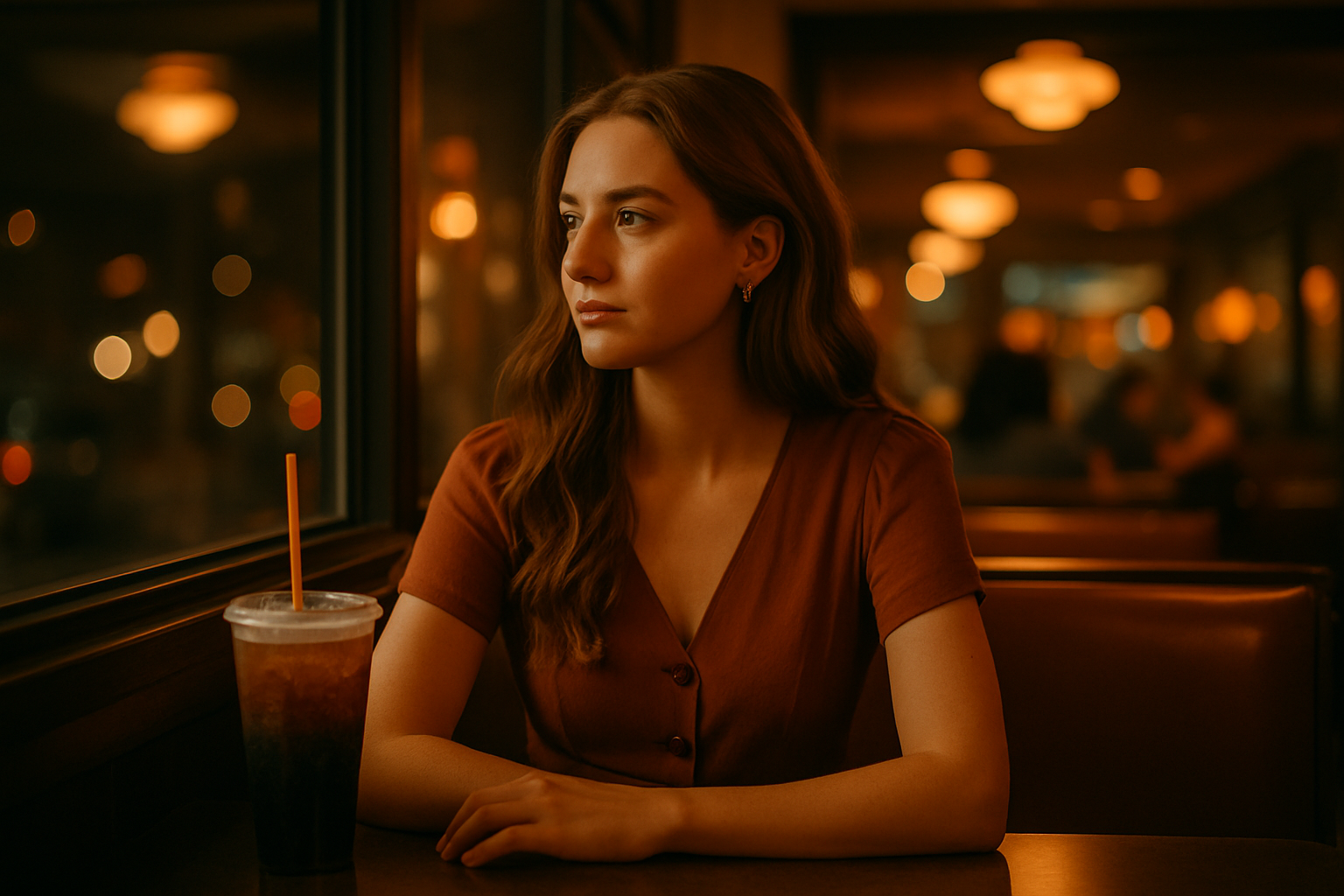
Dating in Provo as a Woman: The Ward Calendar and the Dirty Soda
At nine on a weeknight the drive-through line at a Provo soda shop runs ten cars deep, and a fair share of those cars are dates. The dirty soda, a fountain drink dressed with cream and syrup and lime, is Utah County’s answer to the cocktail, invented for a population that does not drink alcohol or…
Comments
Unisciti per commentareSii il primo a commentare.