Why a Masked Number Beats Handing Over Your Digits
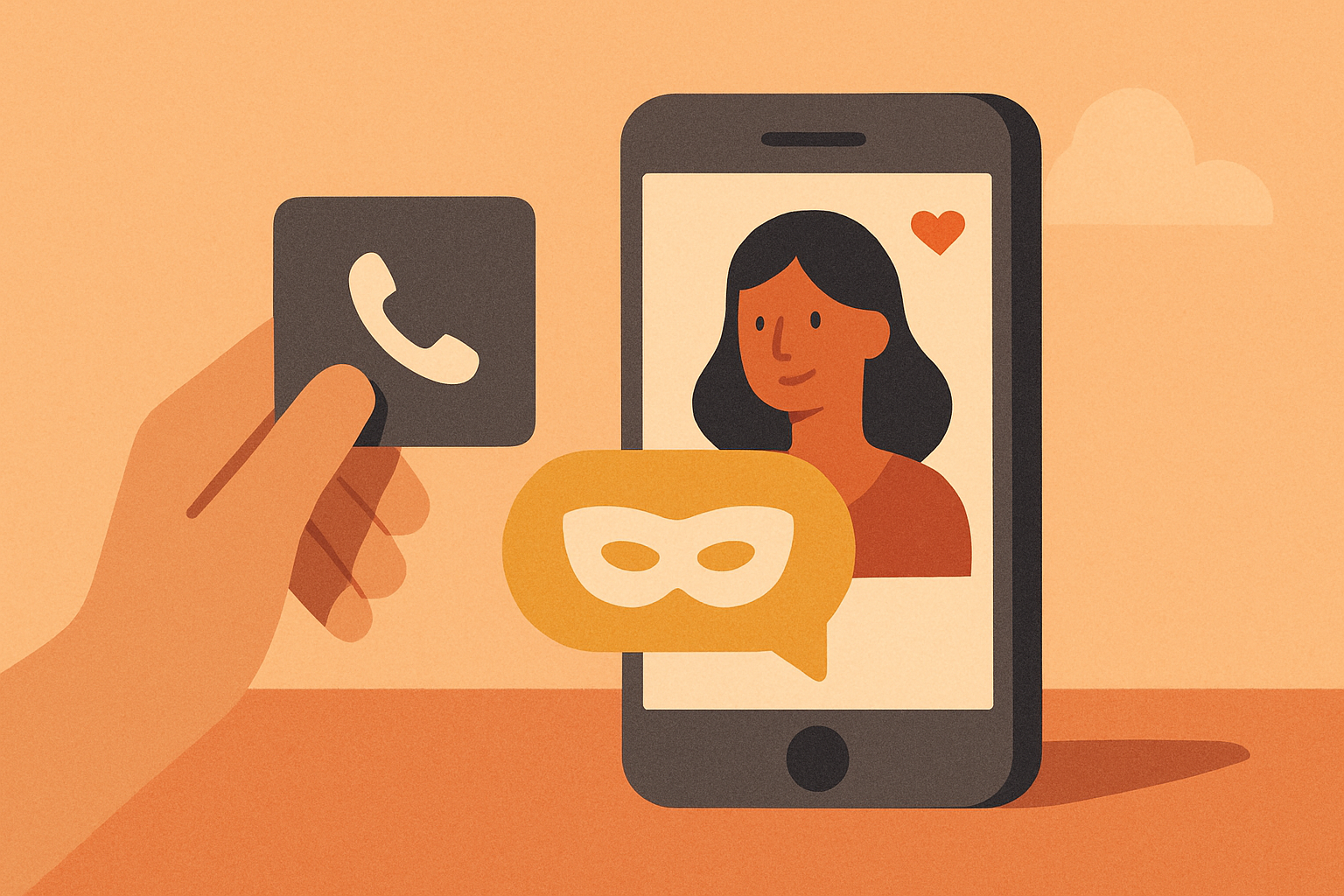
At some point in almost every online dating conversation, you reach the moment of the number exchange. It feels like progress — a sign that things are going well, that trust is building, that you're moving off the app and into real life. And yet for a lot of people, especially women, it's also the moment the anxiety quietly spikes.
Your phone number is not just a way to call you. It's a thread that, in the wrong hands, can be pulled to find your neighbourhood, your workplace, your full name. Handing it to someone you've known for a week — or three days, or one evening — is a bigger deal than the casual ritual of the exchange makes it feel.
This is a piece about why that moment deserves more thought, and what a better version of it looks like.
What Your Phone Number Actually Reveals
Most people underestimate how much information is attached to a mobile number. A quick reverse-lookup search — the kind anyone can run in minutes — can surface your full name, linked social profiles, and sometimes a general location. If your number is connected to a WhatsApp or Telegram account with a profile photo, that's another data point. If it's tied to a business listing, it might surface your employer.
None of this requires technical skill. It requires only that the person on the other end is curious and has fifteen minutes. The vast majority of people you meet online are perfectly decent, but "the vast majority" is not the same as "everyone", and you cannot always tell the difference in the early stages.
There's also the simpler, more common problem: things don't work out. A connection that felt promising fizzles, or one person wants to continue and the other doesn't. Now someone you're trying to quietly distance yourself from has a direct line to you, and blocking them on the app doesn't change that.
The Pressure to Move Fast
Dating apps have inadvertently trained people to treat moving off-platform as a milestone of seriousness. "Let's move to WhatsApp" reads as enthusiasm, as an upgrade in status. Declining can feel like you're being cagey, or that you don't trust the other person — even when your hesitation is entirely reasonable.
This pressure is worth naming, because it's part of why people hand over their numbers before they're genuinely ready. The social script is strong, and breaking it requires an explicit alternative — not just willpower.
How L'Amore Vince Approaches the Contact Exchange
L'Amore Vince structures connection as a progression through four rounds: text chat first, then a voice round, then video, and finally — only after you've cleared all of that — the option to exchange contact details. By the time you reach Round 4, you've heard the other person's voice, you've seen them on video, and you've both actively chosen to keep moving forward at every step. That context changes the weight of the exchange entirely.
At that final stage, L'Amore Vince offers a masked forwarding number as an option for the contact exchange. Instead of sharing your real number, you share a proxy — a number that routes calls and messages to you without ever exposing your actual digits. The other person can reach you. You can respond. But your personal number stays yours until you actively decide otherwise.
Why Masking Works Better Than Alternatives
Some people try to solve the number problem by creating a secondary SIM or using a temporary number service. These work, but they're friction-heavy — you need to manage an extra account, remember to check it, and explain to anyone who notices why you have two numbers. It also can read as evasive if the other person finds out, which is the opposite of what you want when you're trying to build genuine connection.
A masked forwarding number built into the app removes all of that friction. It's not a workaround; it's just how the contact exchange works. There's nothing suspicious about using it, because it's the standard option — both people understand what it is. It normalises privacy protection rather than treating it as an unusual precaution.
Privacy protection shouldn't feel like a red flag. When it's built into the process for everyone, it stops being an exception and becomes the default — which is exactly where it belongs.
The Difference Between Privacy and Secrecy
One concern people sometimes raise: does using a masked number send the wrong signal? Does it imply you're hiding something, or that you're not serious?
The short answer is no — and the longer answer is that the question itself reflects an outdated assumption about what trust means. Trust is not demonstrated by handing over maximum personal information as quickly as possible. Trust is built gradually, through consistent behaviour, shared time, and genuine mutual understanding.
By the time you're at Round 4 on L'Amore Vince, you've already passed through text, voice, and video rounds. You've spoken out loud. You've appeared on camera. You've both demonstrated that you're real, present, and genuinely interested. Choosing to share a masked number at that point isn't a sign of distrust — it's just sensible staging. The relationship is young; the number can follow when it feels right.
Safety Across the Whole Journey, Not Just at the End
It's worth zooming out for a moment. The masked number is one layer of a broader safety architecture on L'Amore Vince. Before you ever get to contact exchange, you've already benefited from the verified streak system — a daily liveness check-in that confirms every active user is a real person. That means the person whose voice you heard in Round 2, and whose face you saw in Round 3, is confirmed to be who they say they are.
The combination matters. Knowing you're talking to a verified real person is one thing. Knowing you can continue that conversation without exposing your personal contact details until you're genuinely ready is another. Together, they create a much more grounded starting point than most apps offer.
Practical Takeaways for Anyone Dating Online
Whether you're using L'Amore Vince or thinking about what safer contact exchange looks like more generally, a few principles hold:
There is no "right" moment to share your real number — there's only the moment that feels genuinely right to you. Timelines imposed by social pressure aren't timelines worth following.
A masked or forwarding number is not evasion. It is a practical, proportionate response to the real risks of sharing personal contact details early.
Someone who reacts negatively to you using a privacy feature has told you something important about how they relate to your boundaries. That information is useful.
Verification matters. Knowing who you're talking to — not just their name, but that they're a consistently present, real person — changes the texture of every subsequent conversation.
The Bigger Picture
L'Amore Vince's whole approach is built on the idea that good connections are built incrementally, with consent at every stage and safety as a default rather than an afterthought. The masked number is a small but meaningful expression of that philosophy. It says: you can move toward someone without giving everything away immediately. You can be genuinely open while still being sensible about what you share and when.
That balance — openness and care, warmth and groundedness — is what makes connection sustainable. The phone number will keep. The relationship it belongs to is worth protecting first.
Ähnliche Beiträge
AI-Generated Profile Photos: How to Spot a Deepfake on a Dating App
On thispersondoesnotexist.com, a website built years ago to demonstrate a particular kind of artificial intelligence, every reload of the page produces a brand-new photograph of a human being who has never existed and never will. Two eyes, a nose, a mouth, skin texture, a plausible haircut,…
The K-1 Fiancé Visa in 2026: Real Costs, Timelines, and Proof
Form I-129F, the petition that starts every K-1 fiancé visa case, currently carries a filing fee of 675 dollars, paid to U.S. Citizenship and Immigration Services (USCIS, the federal agency that adjudicates immigration benefits) the moment a citizen files it on behalf of a foreign fiancé. That…

Pig Butchering Scams: The Money Red Flags to Watch For
In 2023, the FBI's Internet Crime Complaint Center reported $652 million in confirmed losses from romance scams in the United States alone, and investigators say a majority of that money moved through a single, highly organized fraud model known as pig butchering, a term borrowed from the livestock…
Comments
Jetzt mitmachen und kommentieren!Sei der Erste, der einen Kommentar abgibt.